
Sustainability has stopped being a differentiator in packaging. Governments are legislating it, brand owners are reporting on it, and consumers increasingly assume it. What was a competitive advantage five years ago is now a condition of doing business across most global packaging value chains.
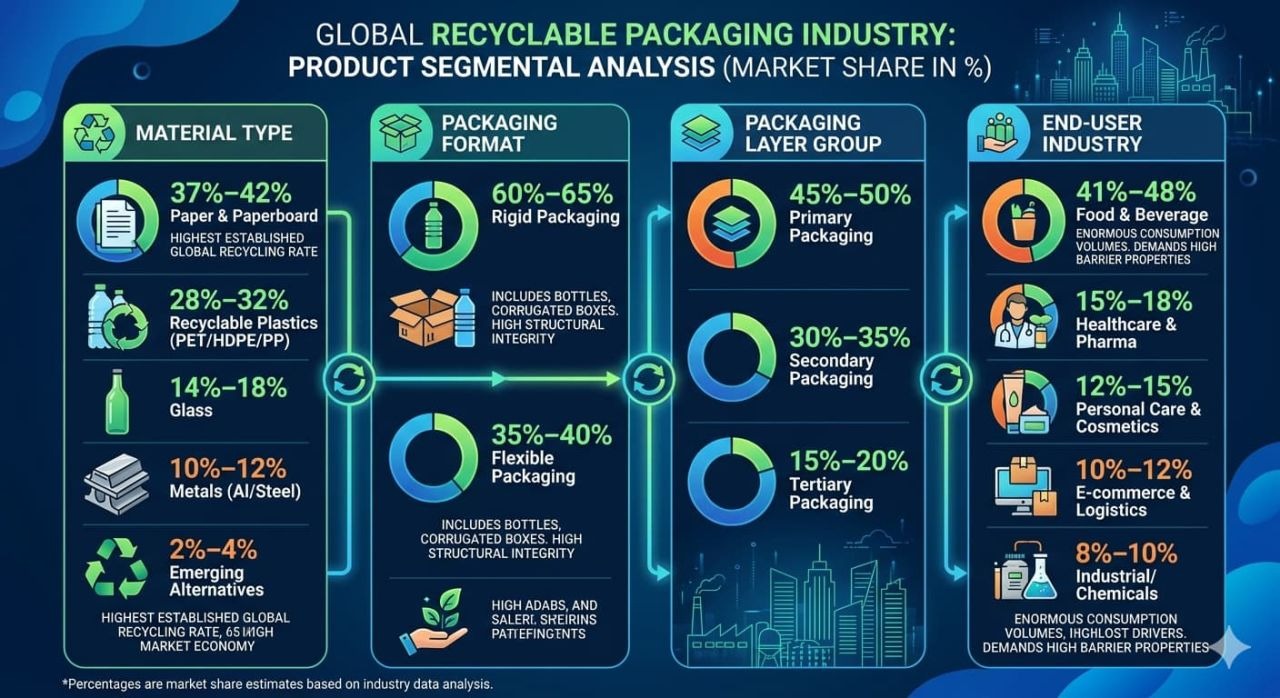
That shift is visible in the numbers. The figures below are market share estimates drawn from industry data analysis, and they are worth reading carefully, because they tell a different story from the one the headlines usually tell.
By material: paper leads, but plastics are not going anywhere
Paper and paperboard take the largest share at roughly 37–42%, helped by a high established recycling rate, wide availability and heavy adoption across food, beverage and e-commerce.
Recyclable plastics — PET, HDPE and PP — follow at around 28–32%. That is the figure most often lost in the public conversation. These polymers remain critical to the market, and the investment going into them is in collection, sorting and recycling infrastructure rather than in replacement.
- Paper and paperboard, 37–42%. The highest established global recycling rate.
- Recyclable plastics (PET, HDPE, PP), 28–32%. Critical materials, with investment flowing into recovery infrastructure.
- Glass, 14–18%. Preferred for premium food, beverage and pharmaceutical packaging for its infinite recyclability and product preservation.
- Metals (aluminium and steel), 10–12%. Consistently high recycling rates.
- Emerging alternatives, 2–4%. Small today, and the segment to watch.
By format: rigid holds the volume, flexible holds the growth
Rigid packaging accounts for about 60–65% of the market. It dominates food and beverage, healthcare and consumer goods on the strength of durability and product protection.
Flexible packaging takes the remaining 35–40%, and the demand behind it is growing for reasons that are straightforwardly material-efficient: lighter weight, lower transport emissions and less material consumed per pack. Corrugated sits alongside both, growing with e-commerce and the shipping requirements that come with it.
By layer: most of the market is the pack you hold
Primary packaging — the layer in direct contact with the product — is 45–50% of the market. Secondary packaging follows at 30–35%, and tertiary, the transport layer, accounts for 15–20%.
By industry: food and beverage sets the pace
Food and beverage is the largest end user at 41–48%, driven by consumption volumes, demanding barrier requirements, and the regulation and sustainability commitments that follow both.
- Food and beverage, 41–48%. Enormous volumes and high barrier demands.
- Healthcare and pharmaceuticals, 15–18%. Adopting recyclable materials while holding product safety constant.
- Personal care and cosmetics, 12–15%. Recyclable packaging as an ESG and consumer-trust measure.
- E-commerce and logistics, 10–12%. Growing with online retail and the demand for recyclable protective packaging.
- Industrial and chemicals, 8–10%.
What is driving it
- Circular economy adoption as a design requirement rather than an aspiration
- Extended Producer Responsibility regulations placing end-of-life cost back on the producer
- Growth in mono-material structures, which are far easier to recycle than multi-polymer laminates
- Investment in advanced recycling technologies
- Consumer demand for alternatives that are genuinely recoverable
What it means
Two things stand out in this data.
The first is that recyclable plastics hold close to a third of the market and are being invested in, not phased out. The direction of travel is better recovery, not substitution for its own sake.
The second is the rise of mono-material design. A pack built from one polymer can actually enter a recycling stream; a three- or four-polymer laminate cannot, however recyclable each layer might be in isolation. That is the same principle behind our own mono-material work.
The companies best placed for what comes next will be the ones that manage all three at once: recyclability, cost efficiency, and the performance the application actually requires. Dropping any one of the three tends to move the problem rather than solve it.