Extended Producer Responsibility is the main lever legislators are using to push packaging towards recyclability. It is now standard across the EU and spreading well beyond it — including into the markets we and our partners sell into.
The principle is simple: whoever puts packaging on the market pays for its end of life. The fee is meant to scale with how difficult that packaging is to recover, so the cost of a hard-to-recycle format shows up on the producer’s own invoice rather than in a municipal budget.
What the paper numbers actually show
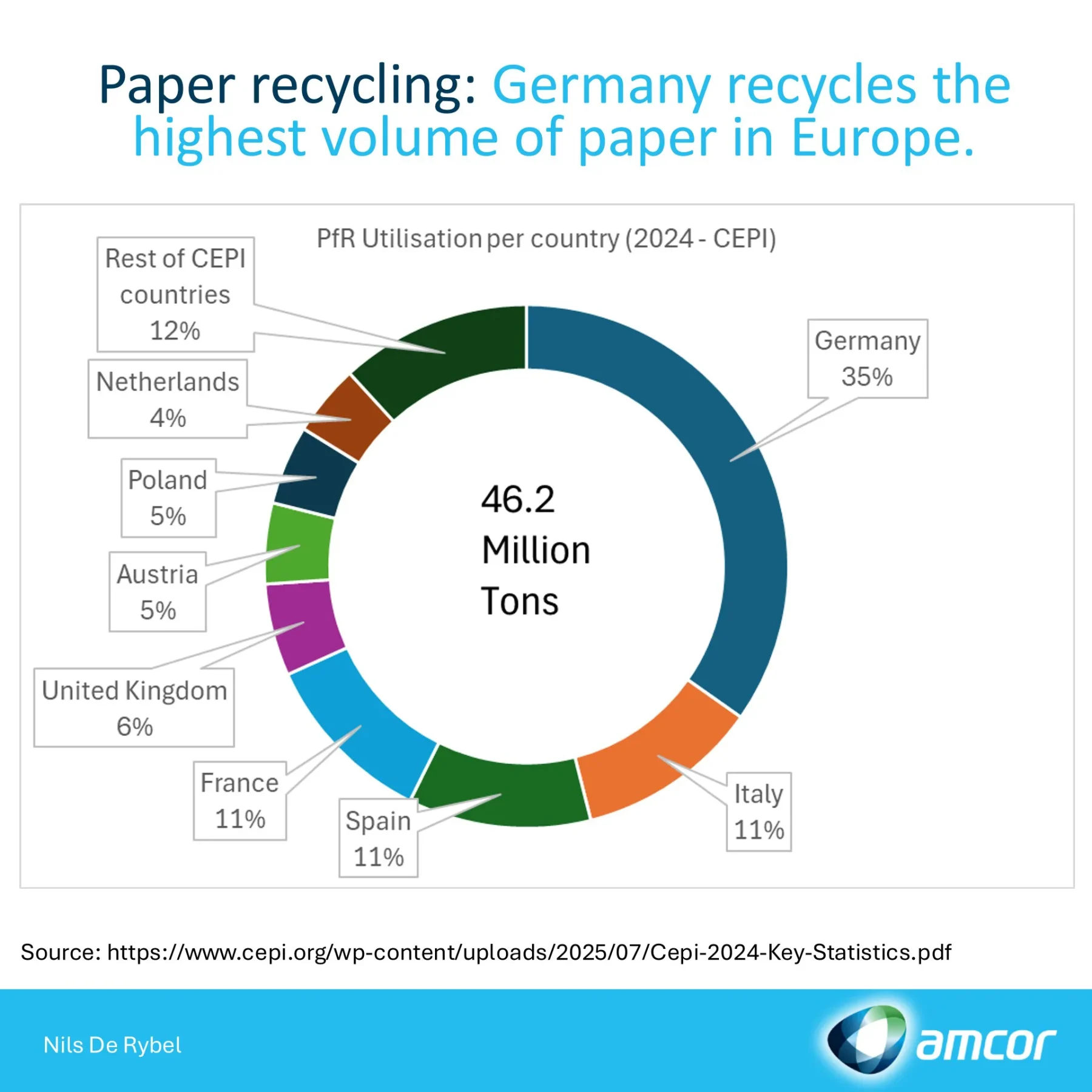
CEPI’s 2024 figures put paper for recycling utilisation across its member countries at 46.2 million tonnes. Germany accounts for about 35% of that. Italy, Spain and France sit at roughly 11% each, the United Kingdom at 6%, Austria and Poland at 5%, the Netherlands at 4%, with the remaining CEPI countries making up around 12%.
One number, two readings
It is worth being precise about what that 35% means, because it is easy to misread — and it usually is misread.
Utilisation measures how much recovered paper a country’s mills consume as raw material. It is a measure of industrial capacity, not of household behaviour. Germany leads because Germany has Europe’s largest paper industry, and that industry needs feedstock.
It does not follow that German consumers separate their waste better than everyone else, and it does not follow that paper is being recovered at the same rate everywhere the chart shows a slice. A country can collect well and process little, or process a great deal of material collected somewhere else.
This is the same caution we would apply to any headline figure about our own material: measure the thing you are claiming, not the thing adjacent to it.
The fees are the unfinished part
Where EPR gets genuinely difficult is in the detail. What the fees fund, how they are calculated, and what they cost all vary considerably across the EU. A producer selling the same pack into several markets can face several different fee structures, several different reporting formats and several different definitions of what counts as recyclable.
That diversity is a real cost, and it falls hardest on the material choice itself: it is hard to design one pack for a continent when the continent cannot agree on how to score it. Producer responsibility organisations working across borders are a step towards harmonisation, but the gap is still wide.
Why this matters outside Europe
EPR schemes modelled on the European approach are arriving in other markets, and exporters feel them first. For anyone shipping into the EU, the fee attached to a pack is becoming as material a design input as the cost of the film itself.
It is another version of the point we keep arriving at: the material is only half the question. What the system around it can measure, charge for and actually recover is the other half.