
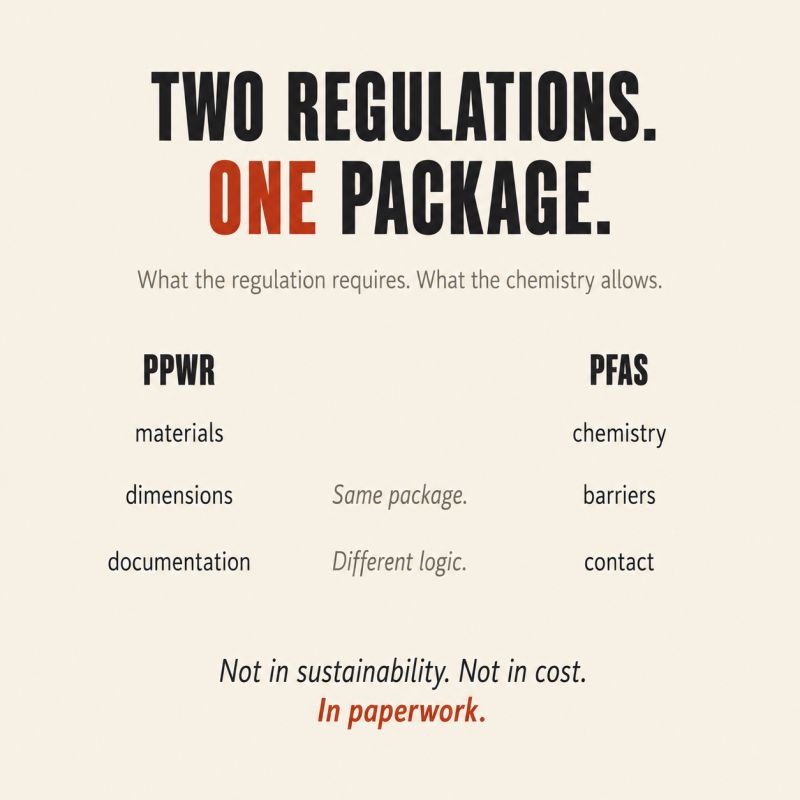
Two regulatory pressures are converging on cold chain packaging at the same time, and they do not share the same logic. Each is reasonable on its own terms. Together they ask an operator to answer two different questions about the same piece of film.
PPWR asks about the package
The Packaging and Packaging Waste Regulation pushes packaging decisions back into the design phase. Every material choice needs to be evidentiable, dimensionally justified, and traceable across the chain.
That is a design-and-paperwork conversation. What is this made of, why is it this size, and can you show the chain of evidence for both?
PFAS pressure asks about the chemistry
At the same time, PFAS restrictions push that same packaging into a chemistry conversation. Which liners, which barrier coatings, which food-contact polymers can still be documented as acceptable?
That is a materials-science question with a compliance deadline attached, and it lands on exactly the components cold chain packaging depends on most: the barrier layers that keep the cold in and the moisture out.
Same package. Different logic.
This is what makes the position awkward. One regime is reasoning about form, material and traceability. The other is reasoning about molecules and contact. Neither is satisfied by the answer that satisfies the other.
- PPWR looks at materials, dimensions and documentation.
- PFAS looks at chemistry, barriers and food contact.
A package can be entirely defensible under one reading and still carry an open question under the other.
Where the decision actually sits
For cold chain operators, the practical problem is not “find a greener alternative”. That framing suggests the obstacle is sustainability, or price, and in most cases it is neither.
The practical problem is that the documentation burden for the old solution is becoming heavier than the documentation burden for switching.
That is the real decision point. Not sustainability. Not cost. Paperwork.
Once the evidence file for keeping a legacy structure costs more to maintain than the evidence file for a simpler one, the economics have already moved, whatever the unit price says.
What that means for material choice
It argues for structures with less to explain. A multi-polymer laminate with a coated barrier layer carries a long list of things that each have to be evidenced, and every one of them is a line in a file somebody has to keep current.
Fewer materials in a structure means fewer questions to answer, under either regime. That is a plainer argument for mono-material design than any sustainability claim, and it is one a compliance team tends to reach on its own.